

Northern Lights Tonight NYC — Can You Actually See Them and Where to Go Right Now
New York City does not do subtle. Every light in the five boroughs burns around the clock, and the combined glow of Manhattan alone is visible from space. So when alerts start circulating about the northern lights tonight NYC residents naturally wonder — is this actually real, or just something happening three states north of us?
Here is the honest answer: it depends entirely on storm strength and where you are willing to drive. From Times Square, no. From a dark field in the Catskills or the eastern tip of Long Island, during a significant geomagnetic event — genuinely yes.
And with solar activity currently near the peak of Solar Cycle 25, the opportunities are more frequent than most New Yorkers realize.
What Makes Northern Lights Visible Near NYC
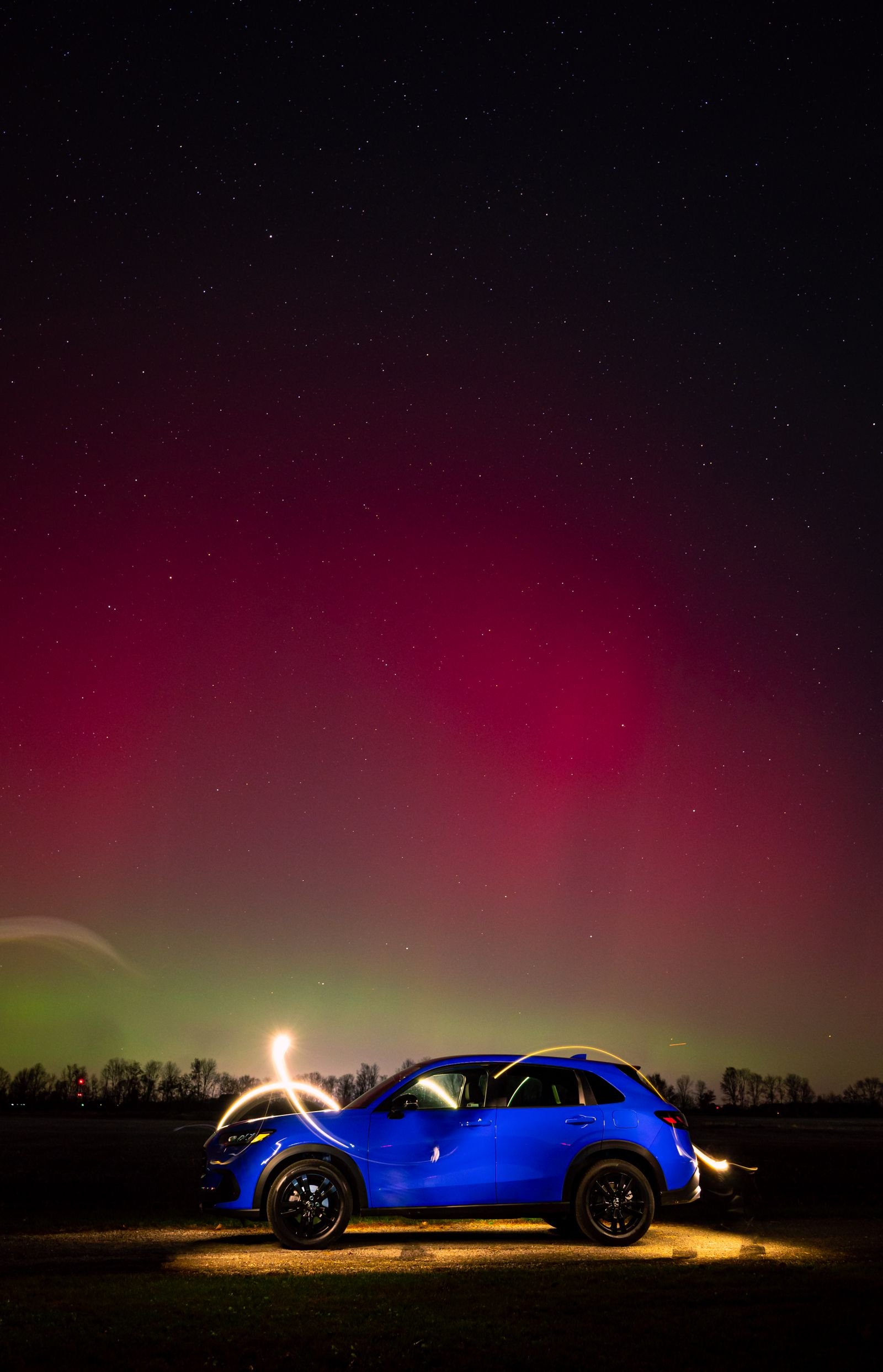
New York City sits at approximately 40 to 41 degrees north latitude. Under normal solar conditions, the aurora borealis stays tucked near the Arctic Circle, thousands of miles away. But during strong geomagnetic storms — rated G3, G4, or G5 on NOAA’s five-point scale — the auroral oval expands dramatically southward.
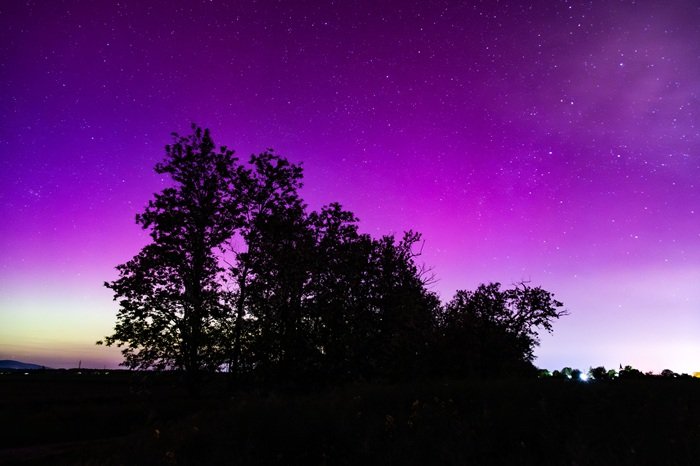
During the historic G5 storm of May 2024, the northern lights were visible across the entire northeastern United States. Confirmed sightings came in from New Jersey, Connecticut, upstate New York, and even from darker corners of Long Island. It was the strongest geomagnetic storm in roughly two decades, and for one night, the question of northern lights tonight NYC shifted from hypothetical to absolutely real.
According to NOAA’s Space Weather Prediction Center, G5 events are rare but not extraordinary during solar maximum periods. The current solar cycle peak, expected to extend through 2025 and taper gradually into 2026, means New York area residents have a meaningful window of opportunity that won’t repeat for another decade.
Why Light Pollution Is Your Real Enemy — Not Latitude
Most people blame NYC’s latitude for making aurora viewing impossible. Latitude is actually only half the problem. The bigger obstacle is light pollution, which is among the worst of any metropolitan area in the world.
The Bortle scale measures night sky darkness from 1 (pristine dark sky) to 9 (inner city). Midtown Manhattan scores a 9. Even the outer boroughs and suburban New Jersey sit at 8 or higher. At those levels, only the moon and the brightest planets are visible to the naked eye on a clear night. Aurora borealis, even during a moderate storm, simply cannot compete with that much artificial light.
This is why chasing northern lights tonight NYC means leaving the city entirely — and knowing exactly where to go.
Rachel K., 29, a graphic designer from Brooklyn, drove to the Delaware Water Gap during the May 2024 storm after seeing alerts on a space weather app: “I left at 9 p.m. with zero idea what I was doing. Pulled off on a dark road in New Jersey and just stood there with my mouth open. My phone camera picked up colors my eyes couldn’t even fully process. I genuinely thought something was wrong with the photo at first. It was the most unexpected beautiful thing I have ever seen outside of New York.”The Best Spots to See Northern Lights Tonight Near NYC
Getting dark sky within reasonable driving distance of New York City is possible — it just requires intentional planning.
Delaware Water Gap National Recreation Area — New Jersey and Pennsylvania border
Roughly 70 to 90 minutes from Midtown depending on traffic, the Delaware Water Gap offers genuine darkness along its western ridgelines. The Appalachian Trail corridor through this area drops into Bortle 4 and 5 territory — dark enough for serious aurora viewing during a G3 or stronger event. Park along Old Mine Road on the New Jersey side and face north.
Catskill Mountains — Ulster and Greene Counties, New York
About two hours north of the city, the Catskills offer some of the closest genuinely dark skies to NYC. The area around Slide Mountain and the Biscuit Brook parking area on Slide Mountain Road sits in Bortle 3 and 4 zones. During the May 2024 G5 storm, multiple photographers confirmed strong aurora displays from this exact area.
Montauk Point — Eastern Long Island
Counterintuitively, driving east rather than north can work during strong events. Montauk sits at the eastern tip of Long Island with an open northern horizon over the Atlantic. The lighthouse area at Montauk Point State Park is dark by Long Island standards — Bortle 4 to 5 — and the reflective water surface can amplify faint aurora displays dramatically. Distance from the city is roughly 2.5 to 3 hours.
Pine Barrens — Southern New Jersey
The New Jersey Pine Barrens cover over a million acres of protected forest and represent one of the darkest large land areas within 90 minutes of Philadelphia and 2 hours of NYC. The area around Wharton State Forest drops to Bortle 3 in its core zones. Face north from any clearing and you have an unobstructed horizon.
What to Check Before You Leave Tonight
Three data points — checked in this order — will tell you whether the drive is worth making.
Kp Index Forecast — NOAA updates aurora forecasts every 30 minutes. For the NYC area at 40 to 41 degrees north, you need a Kp of 7 or higher for reliable naked-eye aurora from dark sky locations. A Kp of 5 or 6 might produce faint camera-visible aurora but is unlikely to deliver a dramatic naked-eye display. A Kp of 8 or 9 means even suburban New Jersey could show something.
Cloud Cover Radar — Not a forecast — a radar loop. Cloud cover moves quickly in the Northeast, and a forecast that shows 40 percent cloud cover can mean the difference between a perfectly clear viewing window and a completely overcast sky. Look for a gap in cloud coverage moving through your target area within a two-to-three hour window.
Bz Component — When the Bz reading on NOAA’s real-time solar wind data drops to minus 10 nanoTeslas or lower and holds there, aurora activity strengthens rapidly. This is the trigger that tells you activity is happening right now, not just predicted.
Camera Settings for NYC Area Aurora Photography
Modern smartphones have become surprisingly capable aurora cameras. iPhone 15 Pro and Google Pixel 8 and newer models with astrophotography or night modes can capture aurora that your naked eye barely registers. Set manually to ISO 1600 to 3200, shutter speed 10 to 20 seconds, widest aperture available. Prop your phone on a stable surface — even a car hood works — rather than holding it.
DSLR and mirrorless camera users should shoot RAW format exclusively. Aurora in the NYC area often appears white or faint pink to the naked eye but renders as vivid green and purple in long-exposure captures. Don’t be discouraged if what you see looks underwhelming — check your camera screen before giving up.
FAQs About Northern Lights Tonight NYC
Q: Can you ever see the northern lights from within New York City itself?
During an extreme G5 geomagnetic storm, faint aurora has been reported from the darkest accessible points within the city — Rockaway Beach facing north, Staten Island’s Greenbelt, and Pelham Bay Park in the Bronx. These are exceptional circumstances rather than reliable viewing conditions. The city’s light pollution makes meaningful aurora viewing from within the five boroughs essentially impossible under normal storm conditions.
Q: How far do I need to drive from NYC to see the northern lights tonight?
During a G3 event, plan for at least 90 minutes to reach dark enough skies — targeting the Delaware Water Gap or southern Catskills. During a G5 event, confirmed sightings have come from locations as close as 60 miles from Midtown. The darker the sky, the shorter the storm needs to be to deliver a visible display.
Q: What app should I use to track northern lights tonight near NYC?
SpaceWeatherLive and My Aurora Forecast are the most widely used apps among aurora hunters in the northeast. Both pull directly from NOAA data and offer push notifications for geomagnetic storm watches and warnings. Set your alert threshold at Kp 6 or higher for NYC-area relevance.
Q: Is the aurora visible every night during solar maximum?
No. Solar maximum increases the frequency of geomagnetic storms but does not produce aurora every night. Most nights remain aurora-free even during active solar periods. Significant viewing events typically cluster around periods of high solar wind activity following large solar flares or coronal mass ejections — both of which NOAA monitors and forecasts.
Q: What is the best month to see northern lights tonight near NYC?
There is no single best month, but aurora activity statistically peaks around the spring and fall equinoxes — March and September — due to the orientation of Earth’s magnetic field relative to the sun. These months also tend to offer better weather windows in the Northeast than the deep winter months, making March and September the practical sweet spot for NYC area aurora hunters.
The northern lights tonight NYC question has a real answer — it just requires honesty about what the city can and cannot offer. Step outside the glow, check your three data points, and drive toward darkness. The aurora does not come to New York. You go to it.
Keep exploring: Best Place for Northern Lights · Northern Lights in Ohio Tonight · Aurora Borealis in Oregon · What Time Is the Lunar Eclipse?
Further reading: NOAA Aurora 30-Minute Forecast · Aurora — Wikipedia

Pingback: Best Place for Northern Lights — From Alaska to Iceland Here Is What Actually Delivers - My Travel Tweaks
Pingback: Ohio Is Seeing the Northern Lights and Here Is How to Catch Them Tonight - My Travel Tweaks