
South America Travel Destinations That Will Permanently Rearrange Your Priorities
Here is a number that stopped me cold when I first read it: South America receives roughly 37 million international tourists a year, yet the continent covers over 6.8 million square miles across 12 countries. Do the math and you realize just how much of it goes completely unseen.
Most U.S. travelers who finally make the trip spend two weeks between Cusco and Buenos Aires and come home thinking they’ve seen South America. They’ve seen two postcards. The continent is larger than the continental United States, Europe, and China combined. It deserves more than a greatest-hits itinerary.
I’ve been traveling to South America for nine years. Here’s what I’d actually tell a friend who’s finally ready to go.
The Azores of South America — Ilha Grande, Brazil
Before the crowds discovered it, Ilha Grande was a maximum-security prison island off the coast of Rio de Janeiro state. The prison was demolished in 1994, and the island has been a protected environmental reserve ever since — which means no cars, no motorbikes, and no large-scale resort development. Ever.
Getting there requires a ferry from Angra dos Reis, about two and a half hours from Rio by bus. Once you arrive, everything moves on foot or by boat. The water at Lopes Mendes beach is the kind of blue that makes you question every beach you’ve ever called beautiful before.
“I almost skipped it because it seemed hard to get to,” admitted Priya, a healthcare worker from Chicago who messaged me after reading one of my earlier posts. “It was the best decision of my entire trip. I stayed three days longer than planned and cried a little when I left.”
That tracks. Ilha Grande does that.
Medellín, Colombia — A City That Rewrote Its Own Story
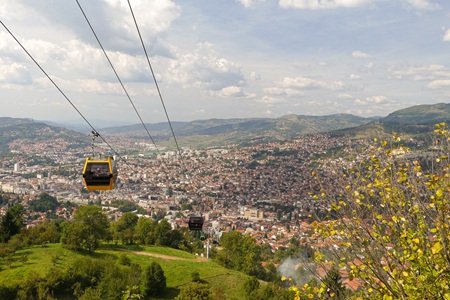
In 1991, Medellín was statistically the most dangerous city on Earth. Today it is a genuine innovation hub, a UNESCO Creative City of Design, and one of the most thoughtfully built urban environments in South America. The city installed a cable car system — the Metrocable — to connect hillside neighborhoods that had been physically and economically cut off from the city center for decades. It worked. Entire comunas transformed.
For U.S. travelers, Medellín offers a striking combination of permanent spring weather (it sits at 5,000 feet elevation and averages 72°F year-round), extremely favorable exchange rates, and a food scene that has quietly become one of the best on the continent. The Laureles neighborhood is where locals actually eat — skip El Poblado for your first night and go straight there.
Flights from Miami run under four hours. There is no good reason Medellín isn’t higher on more American travelers’ radar.
Patagonia — But the Chilean Side, Not Just the Argentine
Everyone says Patagonia. Most people mean Torres del Paine in Chile or the Perito Moreno Glacier in Argentina — both spectacular and both worth every superlative they receive. But fewer U.S. travelers make it to the Carretera Austral, a 770-mile gravel road that winds through Chilean Patagonia past hanging glaciers, thermal springs, and villages of under 200 people.
My friend Joel, a retired schoolteacher from Oregon, drove the Carretera Austral solo in a rented camper van at age 63. He described it as “the first time in years I genuinely didn’t know what was around the next corner — and loved that feeling completely.”
That sense of genuine discovery is increasingly rare in travel. The Carretera Austral still has it.
Budget note: Patagonia is not a budget destination. A well-planned 10-day trip through Chilean Patagonia will run $3,000–$5,000 per person including flights from the U.S. — but travelers consistently rate it among the highest-value experiences of their lives.
FAQs About South America Travel Destinations
Q: What is the easiest South America travel destination for first-time U.S. visitors?
Colombia — specifically Medellín or Cartagena — is consistently the most accessible entry point. No visa required for U.S. citizens, short flight times from Miami or New York, strong tourism infrastructure, and an increasingly large English-speaking hospitality workforce. Cartagena’s walled colonial city is visually stunning and extremely walkable.
Q: Do U.S. travelers need a visa for South America travel destinations?
It depends heavily on the country. U.S. passport holders can enter Colombia, Brazil, Peru, Chile, and Argentina without a visa for tourism stays. Argentina reintroduced a reciprocity fee for Americans in 2023, so confirm current entry requirements before booking. Bolivia and Venezuela require advance visas. Always check the U.S. State Department’s travel page for the most current requirements.
Q: What time of year is best for South America travel destinations?
South America’s seasons are inverted relative to the U.S. — their summer runs December through February, winter June through August. For Patagonia, November through March offers the best trekking weather. For Colombia, December through March is driest. Brazil’s Carnival (late February) is extraordinary if crowds don’t bother you. For Ilha Grande specifically, April through June offers warm weather with dramatically fewer visitors.
Q: How far in advance should U.S. travelers book South America trips?
For Patagonia and the Inca Trail to Machu Picchu, book 6–12 months in advance — permits for the classic Inca Trail sell out completely. For Medellín or Ilha Grande, 2–3 months is generally sufficient outside of peak holiday weeks.
South America travel destinations reward the traveler who comes in curious rather than certain. The continent has a way of quietly dismantling whatever assumptions you arrived with — about safety, about infrastructure, about what a city or a landscape can actually be.
Go with a loose itinerary and real flexibility. The best moments rarely appear on any map you’ll find before you leave.