Bozeman Hot Springs Has Been Running for Over a Century and the Water Still Speaks for Itself
The first thing you notice is what’s missing.
Most hot springs carry that familiar rotten-egg sulfur smell — sharp enough to make you wince when you step out of your car. At Bozeman Hot Springs, it’s absent. The geothermal water here filters through limestone before it reaches the surface, which naturally strips out most of the sulfur compounds. You get all the mineral-rich therapeutic benefit of a genuine hot spring without the odor that typically comes with it. For a lot of visitors, that detail alone makes Bozeman Hot Springs a different experience from every other hot spring they’ve tried.
My friend Carla noticed it the moment she arrived. “I kept waiting for the smell,” she said. “It never came. And then I got in the water and didn’t want to get out for two hours.”
More than 100 years of Gallatin Valley History.
Bozeman Hot Springs has been attracting guests over 100 years. It began as a small pool in the late 1800’s and has since expanded to one of the best-maintained commercial hot springs resort destinations in Montana, a full-facility geothermal resort located 8 miles west of downtown Bozeman, on US 191, the road connecting Bozeman and West Yellowstone and Big Sky Resort.
It is not a random place. Bozeman is located in the Gallatin Valley at 4,820 feet in elevation between the Bridger, Madison and Gallatin mountain ranges. The hot springs are connected to a natural geothermal aquifer which forces the water to the surface at around 141° F and then cooled and sent out over 12 pools on the property. It is located at 150 Welcome Drive, Bozeman, MT 59718 and has received a 4.4/5 rating from thousands of reviews.
The 12 Pools — What the Temperature Range Actually Means
This is the detail that makes Bozeman Hot Springs worth spending time understanding before your visit.
The facility features 12 different pools — both indoor and outdoor — with temperatures ranging from 59°F to 106°F. That 47-degree range is not just a marketing number. It represents a genuine therapeutic progression that experienced soakers use intentionally.
The outdoor pools include four large soaking pools ranging from approximately 90°F to 104°F, surrounded by natural rock patios with lounge chairs. On a Montana winter evening with temperatures hovering around 15°F outside, soaking at 104°F while watching snowflakes dissolve on the surface is one of those experiences that’s genuinely difficult to describe to someone who hasn’t done it.
The cooler pools — down to 59°F — function as cold plunge options, and the hot-to-cold alternation cycle is one of the most well-documented approaches to muscle recovery used by athletes. After a ski day at Big Sky or a hiking day in Yellowstone, the full temperature range at Bozeman Hot Springs is not just relaxing — it is genuinely restorative.
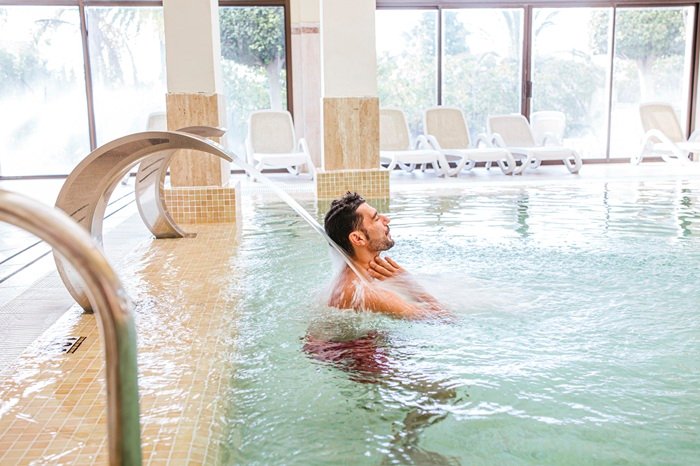
Both dry and wet saunas are available alongside the pools. The indoor pools are a flow-through system — meaning no chemicals are needed and the pools are drained and cleaned every night. That nightly cleaning schedule is the reason the facility consistently earns high marks for cleanliness in guest reviews.
Beyond the Water — What Else Is Here
Bozeman Hot Springs offers more than a soak. The facility includes a full fitness center with Life Fitness equipment — a practical combination for visitors who want to work out and then recover in the mineral pools without driving to two separate locations.
A spa and massage center, tanning rooms, a juice bar, childcare facilities, and swimming lessons round out the amenity set. For families, the dedicated childcare area and shallow pools make Bozeman Hot Springs genuinely workable with young children — not just tolerable.
Live music runs every Thursday and Sunday at 7:00 p.m. On weekend evenings, the outdoor pools are lit with torches, and the combination of warm mineral water, mountain air, and live music creates an atmosphere that has kept Montana locals coming back for decades. Saturday nights are the busiest and can command slightly higher pricing — weekday mornings offer the most relaxed experience and better value.
The Bozeman Hot Springs Campground sits directly adjacent to the facility, offering RV sites with full hookups (50/30/20 amp, water, sewer), standard and deluxe tent sites, and cabins along a creek. Campground registration runs Wednesday through Sunday, 10:00 a.m. to 6:00 p.m. For road-trippers who want to make Bozeman Hot Springs a genuine overnight stay rather than a quick stop, this option is practical and well-reviewed.
The Strategic Stop Most Travelers Miss
Here’s what makes Bozeman Hot Springs worth planning around specifically: its position on US 191.
If you’re driving from Bozeman to Big Sky Resort or continuing south toward Yellowstone National Park — one of the most trafficked routes in Montana — Bozeman Hot Springs is literally on the way. It sits 8 miles from downtown Bozeman, making it workable as a pre-ski morning warm-up, a post-ski evening recovery, or a late-afternoon stop on a Yellowstone road trip.
Most travelers heading that corridor blast right past without stopping. The ones who don’t tend to build it into every subsequent Montana trip.
Admission starts at $17, making it one of the most accessible therapeutic experiences available anywhere along that route — especially compared to resort spa prices at Big Sky.
Real Visitors, Real Reactions
On our way back from Yellowstone we stopped at Bozeman Hot Springs just for the sake of it. My husband and I spent 90 minutes moving between hot and cold pools and left feeling like different people and we’ve already made reservations for ourselves to return.
— Laura M., Colorado traveler
The no-sulfur smell was the first surprise, the cleanliness of everything was the second, and the live music on a Sunday night at an outdoor mineral pool, with the Bridger Mountains in the background was the third.I guess the first surprise was the lack of the sulfur smell, the second was how clean everything was, and the third was discovering live music on a Sunday night at an outdoor mineral pool with the Bridger mountains in the distance – why people move to Montana.
— David R., a Seattle visitor
Frequently Asked Questions
Q: Where exactly is Bozeman Hot Springs located?
Bozeman Hot Springs is located at 150 Welcome Drive, Bozeman, MT 59718 — 8 miles west of downtown Bozeman on US 191, directly on the route to Big Sky Resort and West Yellowstone.
Q: How many pools does Bozeman Hot Springs have?
The facility features 12 pools — both indoor and outdoor — with temperatures ranging from 59°F to 106°F. Both dry and wet saunas are also available.
Q: Does Bozeman Hot Springs use chemicals in the pools?
No. The indoor pools operate on a flow-through system using natural geothermal water, with no chemicals required. Pools are drained and cleaned every night.
Q: Does the water at Bozeman Hot Springs smell like sulfur?
Generally no. The water filters through limestone before reaching the surface, which naturally removes most sulfur compounds — a notable difference from many other hot springs.
Q: How much does it cost to visit Bozeman Hot Springs?
Admission starts at approximately $17. Saturday evenings can be priced slightly higher. Weekday mornings offer the best combination of value and lower crowds.
Q: Is Bozeman Hot Springs good for families with young children?
Yes. The facility has dedicated childcare facilities, shallow pools appropriate for young children, and swimming lessons available. The range of pool temperatures means children and adults can each find a comfortable option.
Q: Is there camping at Bozeman Hot Springs?
Yes. The Bozeman Hot Springs Campground sits directly adjacent to the facility, offering RV hookups, tent sites, and cabin rentals. Campground registration runs Wednesday through Sunday, 10:00 a.m. to 6:00 p.m.
Q: When is the best time to visit Bozeman Hot Springs?
Weekday mornings are the least crowded and most relaxed. Winter visits — especially evenings — offer the unique experience of soaking in hot mineral water while surrounded by snow. Summer visits pair well with hiking and Yellowstone day trips. Live music on Thursday and Sunday evenings at 7:00 p.m. makes those nights worth timing around.
The Bottom Line
Bozeman Hot Springs has earned its 100-year run the straightforward way — clean water, consistent quality, and a setting that makes the experience feel genuinely restorative rather than just recreational. Whether you’re a Montana local who stops in after ski season, a road tripper breaking up the drive to Yellowstone, or a first-time visitor trying to understand why hot springs have such devoted regulars — 12 pools, no sulfur, no chemicals, and live music on a torchlit deck in the Gallatin Valley will answer that question clearly.